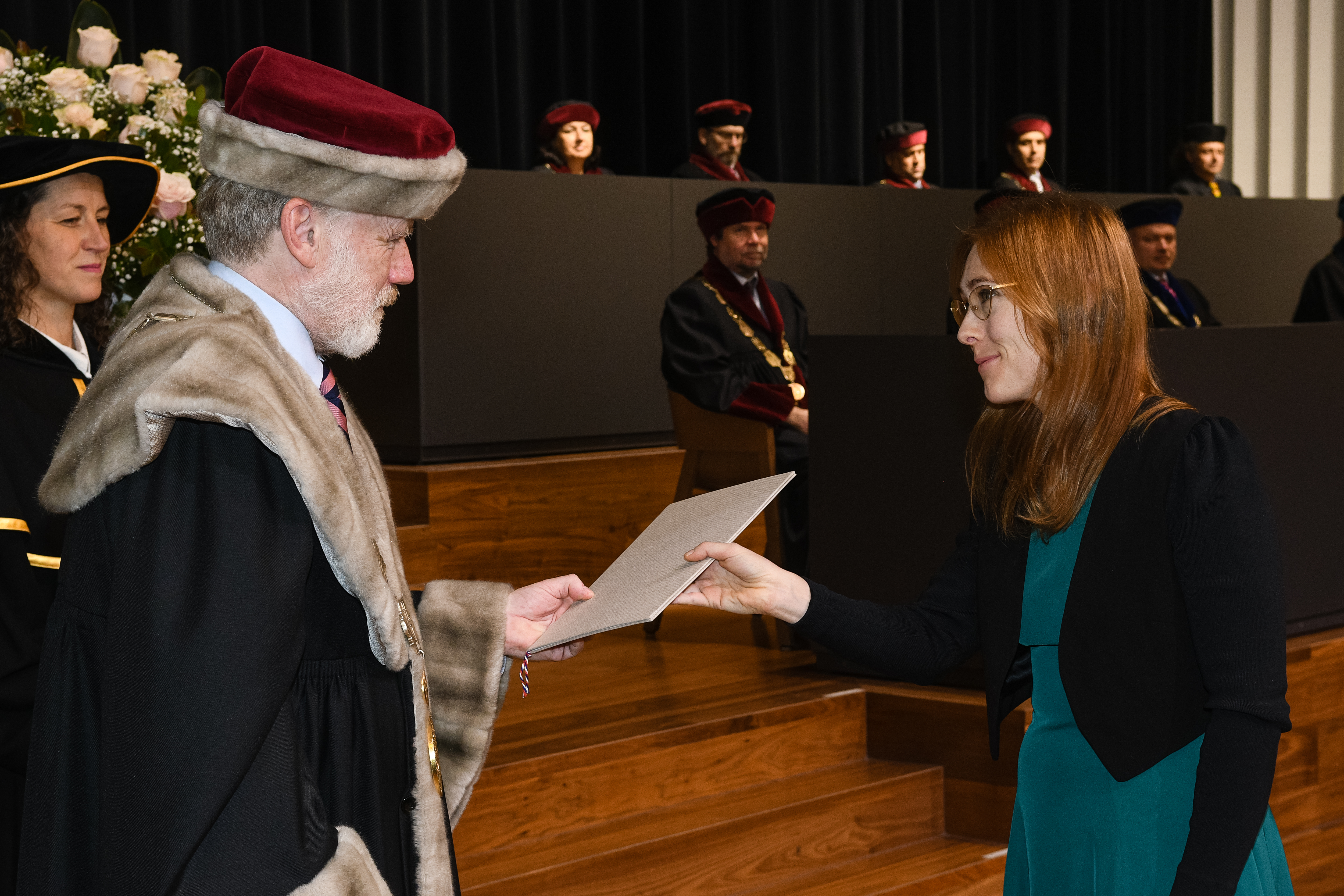

At one end stands a long-term analysis of the development of Czech agriculture since the 1990s; at the other, the decoding of cuneiform and Palmyrene Aramaic using neural networks. Topics that may seem worlds apart at first glance are, in fact, connected by meticulous data work and sustained research effort. It was precisely for such well-conceived and methodologically robust projects that two graduates of the Faculty of Economics and Management (FEM) at the Czech University of Life Sciences Prague received the faculty’s highest honors. Ing. Anna Žovincová, Ph.D., was awarded the Minister of Agriculture’s Prize, while Ing. Adéla Hamplová, Ph.D., received the prof. Stoklasa Prize.
Where Did Czech Self-Sufficiency Go?
In her dissertation, Anna Žovincová undertook a comprehensive analysis of the development of Czech agriculture over a long time horizon, from 1993 to the present. Her motivation stemmed from the conviction that agriculture represents a key pillar of society by ensuring food security—a topic that gained renewed importance following the post-1989 transformation and the Czech Republic’s accession to the EU.
In processing the data, the author compared the effectiveness of a wide range of statistical methods. She did not limit herself to classical trend functions and exponential smoothing, but also employed advanced tools such as Box–Jenkins methodology and neural network models. The results of her investigation revealed fundamental structural changes: a decline in the diversity of cultivated crops and a pronounced contraction of livestock production, particularly in pig farming. The analysis also warns of decreasing self-sufficiency in the production of potatoes, fruit, and vegetables. The dissertation thus serves not merely as a data archive, but as an evidence-based foundation for agricultural policy-making and strategic management in the context of climate change. Reflecting on the demands of her research, Žovincová notes: “Doctoral studies naturally involve alternating periods of success and doubt. More challenging phases are not a sign of failure—they are part of research, and it is important to accept that.”
Deciphering History with a Neural Network
Adéla Hamplová chose a path reminiscent of Lara Croft or Indiana Jones—except that instead of a whip or weapons, she relies on powerful graphics processing units. Her research focused on neural network architectures for object recognition in digital photographs. A fascination with history accompanied her from childhood, when she devoured books about ancient Egypt while simultaneously creating game levels for Tomb Raider—an interest that ultimately led her to study computer science.
In collaboration with universities in Tel Aviv and Ariel, she worked on the analysis of cuneiform script from photographs of temple walls and stelae. She pursued Palmyrene Aramaic in a separate line of research, which was later joined for a time by Professor Alexey Lyavdansky from HSE. A key element of her work was the application of modern instance segmentation methods. This technology, which experienced a major breakthrough in 2023, allows algorithms to precisely delineate individual characters, making it significantly more accurate than traditional OCR (optical character recognition), which often fails with non-printed or damaged scripts. She sums up her pragmatic approach to complex technical challenges with characteristic understatement: “There are no complicated problems in the world—only those that take less time to solve and those that take more.”
No Complicated Problems—Only Long Ones
Although the two award-winning dissertations operate in entirely different domains, they share a common approach: patience, systematic work, and a willingness to overcome research obstacles step by step. Anna Žovincová, under the supervision of Assoc. Prof. Marie Prášilová, Ph.D. (Department of Statistics), worked with time series shaped by political and market changes; Adéla Hamplová, under the supervision of Assoc. Prof. Arnošt Veselý, Ph.D. (Department of Information Engineering), focused on the rapidly evolving field of computer vision. Both emphasize that obstacles are not a signal to give up. Hamplová speaks of the need for repeated trial and error, as well as rest periods during which the brain “puts things in order,” while Žovincová highlights respect for one’s own pace and the importance of choosing topics with genuine societal relevance. Their work demonstrates that research at FEM does not remain locked away in drawers—it reaches from agricultural practice to the digital preservation of cultural heritage.
And what advice do both award recipients offer to fellow doctoral students?
Persevere, do not shy away from challenges, and keep in mind that some problems are not complicated—they simply require more time.